India Dairy Industry 2026: Growing Demand and What Dairy Businesses Must Do
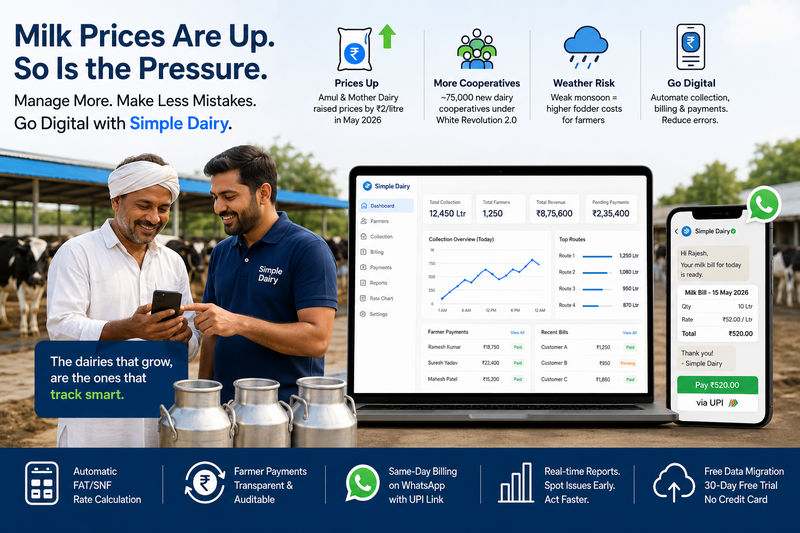
In May 2026, Amul and Mother Dairy raised milk prices by ₹2 per litre — their second hike in 13 months — while India's overall milk production is still projected to grow around 6% in FY27, partly on the back of 75,000 new dairy cooperatives. For small and mid-sized dairy businesses, this combination means more money moving through the system, more farmers to manage, and less room for manual errors to go unnoticed. It's a big part of why dairy management software adoption is accelerating across India in 2026 — the businesses coming out ahead in this cycle are the ones tightening their collection, billing, and payment records now, not after the next price revision.
If you run a dairy — whether it's a delivery round, a milk collection centre, or a retail counter — 2026 has been a year of two things happening at once: prices going up, and the market getting more competitive. Understanding why helps explain why so many Indian dairies are searching for reliable dairy management software this year and quietly moving off paper registers.
The Price Hike, and Why It's Not a One-Off
On 14 May 2026, Amul (through GCMMF) and Mother Dairy both raised milk prices by ₹2 per litre across most pouch variants — buffalo milk went up by ₹4 per litre to ₹80. This was the second hike from both companies within 13 months, and GCMMF was explicit that the increase only partially offsets rising costs: cattle feed, fuel, packaging, and — most relevant to smaller dairies — higher payments to farmers, which GCMMF said had risen roughly 3.7% year-over-year for fat content alone.
Both companies said they're passing roughly 75-80% of consumer milk revenue back to farmers. That's good news for procurement-side income, but it also means the gap between what a dairy pays a farmer and what it charges a customer is under more scrutiny than usual. When margins get tighter industry-wide, the businesses still doing rate calculations by hand are the ones most likely to lose money to small, repeated errors — a slightly wrong SNF/Fat calculation here, a missed farmer payment there.
Where the Growth Is Actually Coming From
Despite the price pressure, India's milk production isn't slowing down. Industry estimates put FY27 output at around 263 million tonnes, up roughly 6% from an estimated 248 million tonnes in FY26 — extending a growth streak that's held for three decades. According to Meenesh Shah, Chairman of the National Dairy Development Board, a big part of that growth is coming from the addition of nearly 75,000 new dairy cooperatives under the government's White Revolution 2.0 initiative, which is specifically designed to pull more villages into the organised procurement network.
This matters for two reasons. First, it means more milk is entering formal supply chains rather than staying in informal, cash-only transactions — which is exactly the environment where dairy management software and digital payment records start to pay for themselves. Second, it means more competition for procurement in areas where new cooperatives are setting up, which puts pressure on existing dairies to keep farmers loyal through faster, more transparent payments rather than just competitive rates.
The Risk Factor: Weather and Fodder
The one wildcard in the FY27 outlook is the monsoon. The India Meteorological Department has flagged the possibility of a below-normal monsoon this year, and a weak monsoon typically means tighter fodder supply, which pushes up feeding costs for farmers well before it shows up in retail milk prices. Dairies that track farmer payments and rate history digitally are in a much better position to spot when a specific route or collection centre is seeing feed-cost pressure early — versus finding out only when a farmer complains or switches to a competitor.
Why Manual Records Struggle to Keep Up — and Where Dairy Management Software Comes In
None of this is new pressure exactly — Indian dairies have dealt with price cycles before. What's changed is the volume. More cooperatives, more farmers, more price revisions in a shorter window means the paper-register workflow that worked fine for a stable market starts to show cracks: rate charts that need updating by hand every time procurement prices shift, collection entries that are hard to cross-check against payments, and billing that lags behind actual deliveries by days rather than hours. This is precisely the gap that dairy management software is designed to close.
The dairies handling this cycle smoothly tend to have three things in common: automatic FAT/SNF-based rate calculation that updates without re-writing a rate chart, farmer payment records that are visible and auditable rather than locked in a notebook, and customer billing that goes out the same day milk is delivered, not at month-end.
What Actually Changes When a Dairy Switches to Dairy Management Software
| Area | Manual register | Digital system |
|---|---|---|
| Rate updates after a price revision | Re-calculate and re-write by hand for every farmer | Update once, applies automatically across all entries |
| Farmer payment disputes | Hard to trace back through old notebooks | Full history searchable in seconds |
| Customer billing after delivery | Often delayed to month-end | Sent same day, via WhatsApp with a UPI link |
| Spotting a problem route or centre early | Usually noticed only after a complaint | Visible in daily reports |
How Simple Dairy's Dairy Management Software Fits Into This
Simple Dairy is one of the dairy management software platforms built specifically for this gap in small and mid-sized Indian dairies. Milk collection from farmers is calculated automatically using SNF and Fat percentages, so a procurement price change updates once and applies across every farmer on the rate chart — no manual re-calculation. Customer billing goes out the same day over WhatsApp with a UPI payment link attached, and every transaction, whether it's a route delivery, a counter sale, or an online order, reconciles into one dashboard. For dairies still on paper, the team migrates existing records for free during onboarding, and the whole thing runs on a 30-day free trial with no credit card required — making it one of the more accessible dairy management software options for a dairy in India testing the switch for the first time.
None of this changes what a dairy does — it changes how fast a dairy can react when procurement prices move, which, based on this year alone, is happening more often than most owners would like.
Three Things Dairy Owners Should Do Before the Next Price Revision
- Audit your current rate chart. If updating it after a price change still means re-writing numbers by hand for each farmer, that's the first place errors creep in.
- Check how fast your billing actually goes out. If customer bills are sitting until month-end, that's cash sitting uncollected for weeks at a time.
- Look at your data as a safety net, not just a record. Digital collection history means you can spot a route or centre under fodder-cost pressure before a farmer walks away over it.
Frequently Asked Questions
Quetion: Why did Amul and Mother Dairy increase milk prices in 2026?
Answer:Both companies cited rising costs for cattle feed, fuel, and packaging, along with higher procurement payments to farmers, which GCMMF said had risen about 3.7% year-over-year. The May 2026 revision was the second hike by both companies within 13 months.
Quetion: Is India's milk production still growing despite the price hikes?
Answer:Yes. Industry estimates project India's milk production will grow around 6% in FY27, reaching approximately 263 million tonnes, supported by better breeding practices, expanded veterinary services, and the addition of nearly 75,000 new dairy cooperatives.
Quetion: How does a weak monsoon affect dairy businesses?
Answer:A below-normal monsoon typically reduces fodder availability, which raises feeding costs for farmers. This pressure usually shows up in farmer payments and rate disputes before it's visible in retail milk prices, making it harder to manage without accurate, up-to-date collection records.
Quetion: Do small dairies need software to handle a price revision, or can a register still work?
Answer:A register can technically work, but every price revision means manually re-writing rate charts for each farmer, which is where calculation errors most often happen. Digital rate calculation applies a price update once, across every farmer automatically.
Quetion: What is White Revolution 2.0?
Answer:It's a government initiative aimed at strengthening India's dairy cooperative network by adding around 75,000 new dairy cooperative societies and reinforcing existing ones, with a target of increasing milk procurement by cooperatives significantly by 2028-29.
Quetion: Which dairy management software is best for a small dairy in India right now?
Answer:The right choice depends on whether the priority is delivery, farmer collection, or both. Platforms like Simple Dairy are built to handle automatic SNF/Fat rate calculation, WhatsApp billing, and counter sales together, which suits a dairy managing multiple parts of the business from one system rather than juggling separate tools.
Quetion: Is dairy management software worth it for a small dairy, or only for large operations?
Answer: It's worth it at almost any scale, since the core problem — rate calculation errors, delayed billing, and untraceable farmer payments — affects a 30-customer delivery round just as much as a large dairy. Per-customer pricing models mean the cost scales with the size of the business rather than requiring a large upfront investment.
Milk prices are unlikely to stay flat through the rest of 2026 — GCMMF itself has said the May revision only partially offsets rising costs, and further hikes are possible if fodder pressure continues. For dairy owners, the practical takeaway isn't to predict the next price move. It's to make sure that whenever it happens, updating rates, paying farmers correctly, and billing customers on time doesn't depend on someone doing the math by hand at 5 AM.
 WhatsApp