How Milk Delivery Software Helps Dairy Businesses Save Time, Money, and Customers in 2026
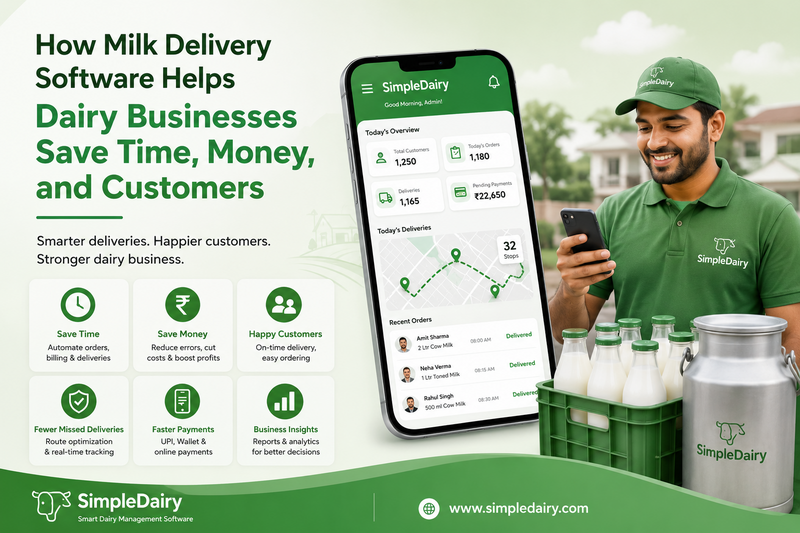
See how milk delivery software cuts costs, reduces missed deliveries, and grows customer loyalty. A practical, real-world guide for dairy owners in 2026.
Introduction: The Real Cost of "Doing It the Old Way"
Ask any dairy business owner what their biggest headache is, and you'll usually hear the same three things: missed deliveries, late payments, and customers switching to a "better" vendor down the street.
None of these problems happen because the owner isn't working hard enough. They happen because manual systems — paper registers, phone calls, and memory — simply can't keep up once a business grows past a certain size. A milkman who serves 50 households can manage things in his head. The moment that number crosses a few hundred, small mistakes start turning into lost customers and lost money.
This is where milk delivery software quietly changes the game. It's not just a fancy app — it's a practical tool that fixes the exact problems that cost dairy businesses money every single day. In this guide, we'll look at the real, everyday impact of using this software, not just a list of features, so you can decide if it's worth it for your business.
The Hidden Costs Most Dairy Owners Don't Notice
Before talking about the solution, it helps to see where money and time actually leak out in a manual system:
- Missed deliveries mean refunds, complaints, and sometimes a customer who never orders again
- Manual billing errors — over-charging or under-charging — quietly eat into profit margins every month
- Time spent on phone calls confirming orders is time not spent growing the business
- Payment follow-ups for defaulters can take hours every week
- No visibility into which areas are profitable means marketing and delivery effort often goes to the wrong places
Most owners don't calculate these costs because they're spread out and invisible. But add them up over a year, and they're often larger than the cost of the software itself. This is the real argument for adopting a dairy management software — not because it looks modern, but because it directly protects revenue that's currently slipping through the cracks.
What Milk Delivery Software Actually Does (In Plain Terms)
Strip away the technical jargon, and milk delivery software does three simple things:
- It remembers everything — every customer's order, every holiday, every pending payment — so nothing depends on someone's memory
- It automates repetitive tasks — generating tomorrow's orders, creating bills, assigning delivery routes
- It connects the business owner, delivery staff, and customers on one shared system, so everyone sees the same accurate information
That's it. There's no need to overcomplicate it. A good milk delivery app simply takes the tasks that used to depend on memory and paper, and turns them into something that happens automatically and correctly, every single day.
Real Problems, Real Solutions
Let's look at how this plays out in everyday situations that most dairy businesses face.
"My delivery boy forgot two houses again"
With route-based delivery software, agents get a fixed, ordered list for their area every day. Nothing depends on memory, and every stop is marked complete only after delivery, so missed houses are caught immediately instead of discovered through a complaint call the next day.
"Customers keep asking to change their order at the last minute"
A subscription system lets customers modify quantity or pause delivery themselves through an app, right up to a cutoff time. The business owner doesn't need to take a single phone call for this anymore.
"I never know who has paid and who hasn't"
Automated billing tracks every delivery against every payment in real time. Instead of manually checking a register, the owner can see a clear list of pending payments at any moment.
"I don't know if my business is actually growing"
Basic reporting shows daily and monthly sales trends, which areas are growing, and which customers are inactive — data that's simply not visible in a paper-based system.
These aren't hypothetical benefits — they're the day-to-day frustrations that push most dairy business owners to eventually adopt some form of milk delivery management system.
Manual System vs Software-Based System
| Task | Manual System | Milk Delivery Software |
|---|---|---|
| Taking orders | Phone calls, memory | Self-service app |
| Route planning | Manual, daily | Automated, optimized |
| Billing | Handwritten, error-prone | Automatic, accurate |
| Payment collection | Cash, in-person | UPI, wallet, auto-debit |
| Tracking deliveries | No visibility | Real-time status |
| Business insights | None | Reports & analytics |
| Scalability | Difficult past ~100 customers | Easy, even for thousands |
This comparison is exactly why so many small and mid-sized dairy businesses are switching over — not because software is trendy, but because the manual system genuinely breaks down as the business grows.
How to Start Using Milk Delivery Software: A Simple Step-by-Step Approach
If you're convinced this is worth trying, here's a practical way to go about it without disrupting your existing business:
Step 1: List your actual pain points Is it missed deliveries? Late payments? No visibility into sales? Knowing your biggest problem helps you evaluate software based on what actually matters to you.
Step 2: Try it with a small group first Don't switch your entire customer base overnight. Onboard 20-30 customers on the new system while keeping the rest on your existing process, and compare results after two weeks.
Step 3: Train your delivery staff properly Most delivery software failures happen not because the software is bad, but because delivery agents weren't shown how to use it properly. A 15-minute walkthrough usually solves this.
Step 4: Communicate the change to customers clearly A simple message explaining how to download the app and place orders goes a long way in getting adoption right from day one.
Step 5: Review your data after 30 days Look at your reports — missed deliveries, payment collection speed, and customer feedback — and compare it to your old system's performance.
This gradual approach reduces risk and builds confidence in the new system before a full rollout.
Common Mistakes to Avoid When Choosing Software
- Choosing the cheapest option without checking support quality — a low price is meaningless if there's no one to help when something breaks
- Ignoring your delivery staff's comfort with technology — if agents can't use it easily, adoption fails regardless of features
- Not checking if it supports local payment methods — UPI and wallet support matter far more than flashy dashboards
- Skipping the trial period — always test with a small group before a full switch
- Overlooking data security — customer payment information needs to be handled responsibly
Avoiding these mistakes is often more important than picking the "best" software on paper — a decent tool used well beats a great tool used poorly.
Why This Matters More in 2026 Than Ever Before
Customer expectations have shifted. People who order groceries, food, and cabs through apps now expect the same convenience from their milk delivery too. A business that still relies purely on manual processes risks looking outdated compared to a competitor offering app-based ordering and digital payments — even if the milk quality is identical.
At the same time, digital payments have become second nature for most households, and customers are far more comfortable paying through UPI or wallets than keeping cash ready every month. This shift alone makes adopting an online milk delivery app less of an upgrade and more of a basic expectation.
Frequently Asked Questions (FAQs)
Q1. Is milk delivery software only useful for large businesses?
No. Even small vendors with 50-100 customers benefit significantly, mainly through reduced missed deliveries and easier payment collection. The benefits simply scale up as the business grows.
Q2. Will my delivery staff find it difficult to use?
Most modern delivery software is designed to be simple, often requiring just a few taps to mark a delivery complete. With a short training session, most delivery agents adapt within a day or two.
Q3. What happens if a customer doesn't have a smartphone?
Many software solutions allow the admin or delivery agent to place and manage orders on behalf of such customers, so they aren't excluded from the system.
Q4. How quickly can I expect to see results after switching?
Most businesses notice a reduction in missed deliveries and faster payment collection within the first month, while full data-driven benefits usually show up after 2-3 months of consistent use.
Q5. Is customer data safe with this kind of software?
Reputable software providers use encrypted payment gateways and secure servers. It's important to check this specifically before choosing a provider, rather than assuming all software is equally secure.
Conclusion
Milk delivery software isn't about replacing the personal touch that dairy businesses are known for — it's about removing the everyday friction that quietly costs time, money, and customers. Missed deliveries, billing errors, and payment delays aren't signs of a badly run business; they're simply the natural limits of doing everything manually.
The businesses that adopt the right tools now aren't just solving today's problems — they're building a foundation that can handle tomorrow's growth without breaking under the pressure of more customers, more areas, and more complexity.
If missed deliveries, payment delays, or lack of business visibility sound familiar, it might be time to look at how the right software could quietly solve them for you.
Learn More: www.simpledairy.com
 WhatsApp