Dairy Management Software in India: The Complete Guide for Dairy Owners
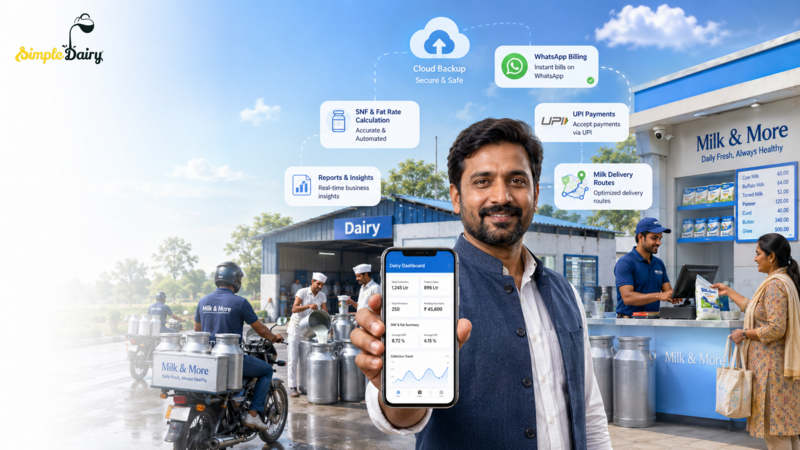
Confused between paper registers and dairy software? This guide explains what dairy management software does, its must-have features, real cost, and how to pick the right one for your dairy in India.
If you run a dairy in India — whether it's a 30-customer milk round in a small town or a multi-branch operation with counters, farmers, and delivery boys — you already know the real problem isn't making milk. It's managing everything around the milk: who paid, who didn't, which farmer's rate changed today, and why the register never quite matches the cash in hand.
This is exactly the gap that dairy management software is built to close. In this guide, we'll walk through what this kind of software actually does, the features that matter most for Indian dairies, how much it costs, and how to evaluate one before you commit.
What Is Dairy Management Software?
Dairy management software is a digital system that replaces the paper register, WhatsApp groups, and separate notebooks most dairies still rely on. Instead of tracking customers, farmers, routes, bills, and dues by hand, everything sits in one app — accessible from a phone, updated in real time, and backed up automatically.
At its core, good dairy management software in India handles four things every dairy deals with daily:
- Customer billing and collections — generating bills, sending them out, and getting paid
- Milk delivery and route management — who gets how much milk, on which route, every single day
- Milk collection from farmers — calculating rates by SNF and Fat content, and settling payments on time
- Reports and reconciliation — knowing exactly how much money came in, went out, and where the profit actually is
Some platforms also add a counter sales POS for dairy booths and parlours, and a branded customer app so the dairy's own name — not a third-party brand — shows up on every bill and order.
Why a Generic Business App Doesn't Work for Dairies
A lot of dairy owners try generic billing or accounting apps first, and most give up within a few weeks. The reason is simple: milk isn't a normal retail product.
Rates change based on Fat and SNF percentage, not just quantity. Deliveries repeat daily with constant leave and pause requests. Farmers need to be paid on a shift-by-shift basis, not monthly. None of this fits into a standard invoicing tool built for shops or freelancers.
This is why dairy management software built specifically for India — with SNF/Fat auto-rate calculation, route-based delivery, and WhatsApp-first billing — tends to work far better than adapting a generic tool.
Must-Have Features to Look For
When comparing options, here's what actually separates a useful system from a half-built one:
1. Milk Delivery Management
Daily, alternate-day, and custom delivery frequencies; auto-updating routes for delivery staff; one-tap bulk marking so a delivery boy doesn't have to update 30 stops one by one; and an easy way to handle customer leave or vacation pauses without losing track of it in a margin note.
2. Milk Collection From Farmers
This is where a lot of software falls short. Look for automatic rate calculation by SNF and Fat (with manual override when needed), per-farmer or per-shift rate charts, and a daily WhatsApp slip so farmers see exactly what they were paid and why — which is often the single biggest source of trust between a dairy and its farmers.
3. WhatsApp Billing and UPI Collection
Bills generated instantly and sent on WhatsApp with a UPI payment link cut collection time from weeks to seconds. This one feature alone is usually what convinces dairy owners to make the switch, since chasing dues by phone call is the most time-consuming part of running a dairy.
4. Counter Sales / POS
For dairies that also run a booth or parlour, a fast point-of-sale system that bills in a few taps, accepts cash, UPI, and cards, and syncs stock automatically across multiple counters saves real time during peak hours.
5. Reports That Actually Drive Decisions
Daily sales reports, product-wise profitability, dues lists, and expense tracking matter more than they sound. Many dairy owners only discover which products are actually profitable — and which ones are quietly losing money — once they can see product-wise reports for the first time.
6. Data Backup and Export
A paper register that gets wet, lost, or torn means losing years of customer history. Any software worth using should offer automated daily backups and let you export your full data as Excel whenever you want — your data should stay yours, not locked into the platform.
Paper Register vs. Dairy Management Software
| Task | Paper Register | Dairy Management Software |
|---|---|---|
| Generate a bill | Hand-written, several minutes | Sent on WhatsApp in seconds |
| Collecting payment | Follow-up calls for weeks | UPI link, often paid within a minute |
| Route management | Verbal instructions each morning | Auto-updated route on the delivery boy's phone |
| Month-end report | One or two full days of manual counting | Ready instantly, exportable to Excel |
| Dues reminders | Easy to forget half of them | Automated WhatsApp and SMS reminders |
| Multiple counters | Separate notebooks per counter | One dashboard for all counters |
| Data safety | Gone if the notebook is damaged | Daily automated cloud backup |
The pattern across most dairies that switch is similar: faster collections, fewer missed deliveries, and far less time spent reconciling cash at the end of the day.
What Does Dairy Management Software Cost in India?
Pricing in this category usually falls into two models:
- Per-customer pricing — often around ₹1 to ₹2 per customer per month, which scales naturally as the dairy grows and stays affordable for small operations
- Custom/enterprise pricing — for dairies that want a fully white-labelled app under their own brand name, published on the Play Store and App Store under their business
Most reputable providers, including Simple Dairy, offer a free trial period with every feature unlocked and no credit card required, so a dairy can test the actual daily workflow — billing, collection, routes — before paying anything.
How to Choose the Right Dairy Management Software
Before signing up, it helps to ask a few direct questions:
- Does it handle SNF/Fat-based rates automatically, or will you still be doing that math by hand?
- Is billing and payment collection WhatsApp and UPI-based, since that's how most Indian customers already pay?
- Can it scale from a small delivery round to multiple counters and branches without needing to switch systems later?
- Is there a genuinely free trial, or does it require payment details upfront?
- Will they migrate your existing paper register for free, so you don't lose years of customer and farmer history?
- Does it support regional languages, since many delivery staff and farmers are more comfortable in Hindi or a local language than English?
- Can you export your own data anytime, in case you ever want to move to a different system?
A platform like Simple Dairy's milk delivery and milk collection modules is built around exactly this checklist — SNF/Fat auto-rates, WhatsApp billing, free register migration, and support in 9+ Indian languages.
Real Results Dairies Have Reported After Switching
Numbers from dairies that moved off paper registers tend to follow a consistent pattern: faster dues recovery once WhatsApp and UPI reminders replace manual follow-up calls, meaningful time saved each morning once routes update automatically instead of needing phone calls at 5 AM, and clearer product-wise profit visibility once owners can finally see which items are actually making money. Several dairy owners have also reported zero rate disputes with farmers after switching to automatic SNF/Fat-based rate calculation, and zero cash mismatches once counter, online, and route sales all reconcile from a single dashboard.
Frequently Asked Questions
Question: What is dairy management software used for?
Answer: It's used to manage the day-to-day operations of a dairy business — customer billing, milk delivery routes, milk collection from farmers with SNF/Fat-based rates, counter sales, and financial reporting — all from one system instead of paper registers and scattered notebooks.
Question: Is dairy management software useful for a small dairy with 30–50 customers?
Answer: Yes. Most platforms are built to work for small delivery rounds just as well as large multi-branch operations, and pricing models like per-customer billing make it affordable even at a small scale.
Question: How does SNF/Fat-based rate calculation work in dairy software?
Answer: The software takes the Fat and SNF (Solids-Not-Fat) percentage recorded for each farmer's milk and automatically applies the correct rate per litre based on a pre-set rate chart, removing the need for manual rate-chart lookups every shift.
Question: Can dairy software send bills directly on WhatsApp?
Answer: Yes, most modern dairy management platforms generate the bill and send it as a WhatsApp message along with a UPI payment link, so customers can pay directly without a separate app.
Question: What happens to my existing paper register data if I switch?
Answer: Reputable providers offer free data migration — you send a photo of your register or an Excel sheet, and their team digitises your customers, products, routes, and balances before you go live.
Question: Does dairy management software work in Hindi or regional languages?
Answer: Many platforms, including Simple Dairy, support 9 or more Indian languages so delivery staff and dairy owners can each use the app in the language they're most comfortable with.
Question: Is it safe to store dairy business data on this kind of software?
Answer: Look for providers that use HTTPS encryption, firewall-protected servers, and daily automated backups, and that let you export your complete data as Excel at any time.
Dairy management software isn't about replacing the dairy business you've built — it's about removing the manual work that eats into your morning, your dues collection, and your month-end reconciliation. For most Indian dairies, the real decision isn't whether to move off paper, but which system handles SNF/Fat rates, WhatsApp billing, and route management well enough to actually save time from week one.
 WhatsApp